What makes a face attractive? The meaning of attractive, and what research shows
Attractive means pleasing to look at, or able to draw people in. For faces, decades of studies point to a short list: averageness (features close to the population mean), symmetry, typical male or female features, clear and even skin, and a warm expression. People agree a lot about who looks attractive, but personal taste counts about as much as shared taste.
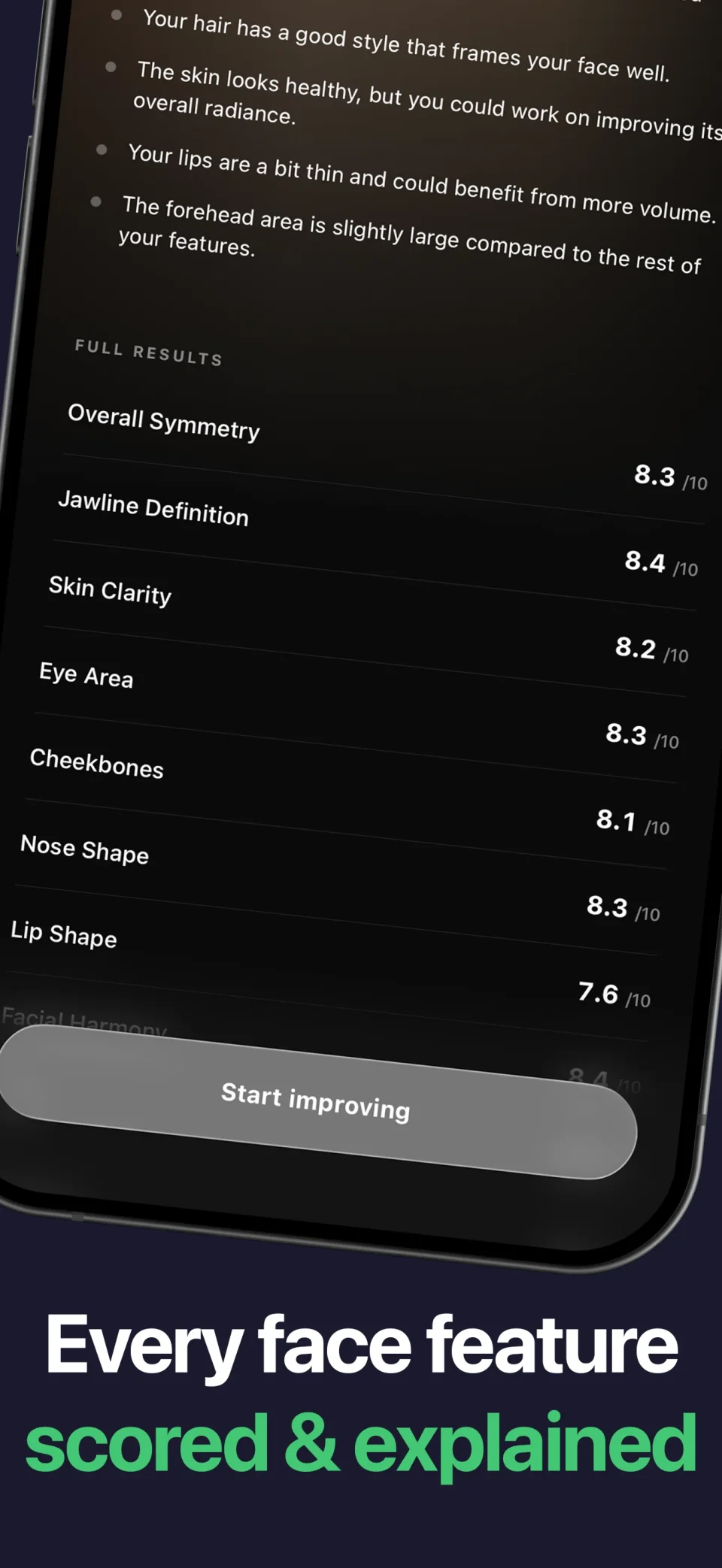
Lookist scores 15 features from one front photo, including symmetry, harmony and 4 skin scores.
Download Lookist for iPhoneWhat does attractive mean?
Dictionary.com defines attractive as 'providing pleasure or delight, especially in appearance or manner'. The word is old. It was first recorded between 1375 and 1425 and comes from the Late Latin attractivus, which described a medicine with 'drawing power'. That root still fits: an attractive face is one that pulls attention toward it.
Attractive is wider than good looking. A personality, a voice or a way of moving can be attractive too. This page is about the face, the part that researchers have measured most.
Hotness is the slang version. The Cambridge Dictionary lists hot as an informal word for sexually attractive. Hotness and attractiveness overlap, but hotness leans on sexual appeal, while attractive also covers a face that looks kind, healthy or pleasant.
What does conventionally attractive mean?
Conventionally attractive means attractive by the common beauty standard of a time and place. The Cambridge Dictionary defines conventionally as 'in a way that is traditional and ordinary', and gives the example 'She is not conventionally beautiful, but there is something very attractive about her'.
So a conventionally attractive face matches what most people around you would call good looking. An unconventionally attractive face breaks one of those rules and still draws people in. Both are real. The difference is how many people agree.
Standards are partly learned. In a 1998 study in Nature, people in the UK and Japan both preferred more feminine female faces, but the preference was stronger for faces from their own population. The authors read that as a sign that some beauty cues are learned from the faces around us.
Source: Perrett and colleagues, 1998: effects of sexual dimorphism on facial attractiveness (Nature)
What makes a face attractive, according to research?
Facial aesthetics is the study of how a face looks and why some faces please more than others. Psychologists have tested it for decades with photos, averaged faces and large panels of raters. Two reviews sum up the main factors: Rhodes (2006) and Little, Jones and DeBruine (2011). The table lists them, with what the evidence says and what a person can change.
| Factor | What studies found | Can you change it? |
|---|---|---|
| Averageness | Blends of many faces beat almost every single face in them | No, it is mostly bone structure |
| Symmetry | More symmetrical faces are rated more attractive, in men and women | Only a little, through grooming and photo setup |
| Male or female typical features | Feminine female faces are preferred. Preference for masculine male faces varies | Mostly no |
| Skin | Even skin color and texture look healthier and more attractive | Yes, partly, with sun protection and skin care |
| Expression | A smile raised attractiveness enough to make up for a less attractive face | Yes |
| Face fat | Lower facial fat predicted higher ratings in both sexes | Partly, with body weight |
Why are average faces attractive?
Average here does not mean ordinary. It means close to the mathematical middle of many faces. In 1990, Judith Langlois and Lori Roggman digitally blended photos of men and women into composite faces. Adults rated the composites as more attractive than almost all of the single faces that went into them. The more faces they blended, the more attractive the composite became.
Two ideas explain it. A face near the middle of the population is easy for the brain to process, because it looks like a typical member of the category 'face'. And features near the average may signal healthy, normal growth. Researchers still argue about the second idea.
Averaging also smooths skin and evens out the 2 sides, so part of the effect comes from symmetry and skin. The 2006 Rhodes review still lists averageness as its own factor, next to symmetry.
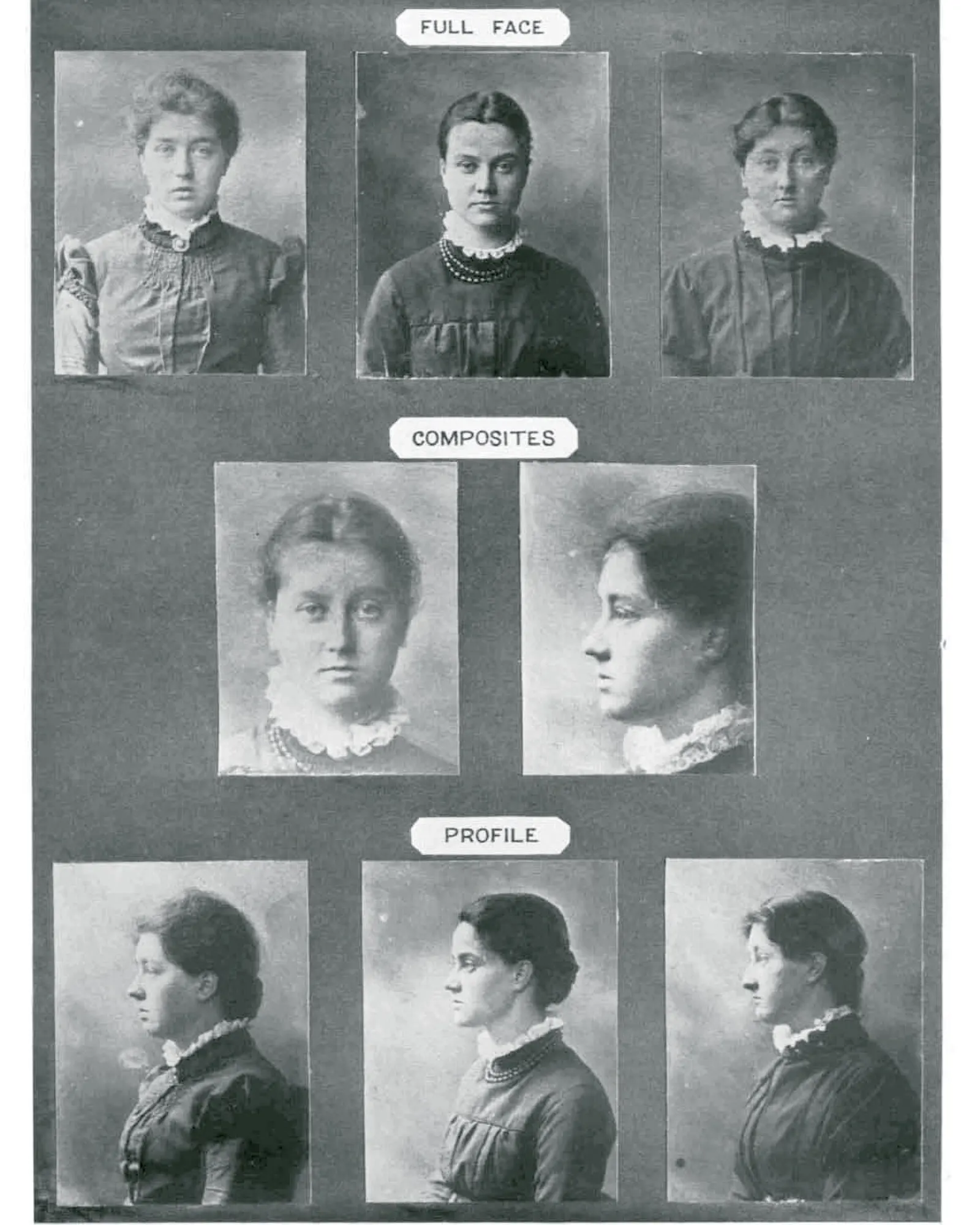

Source: Langlois and Roggman, 1990: attractive faces are only average (Psychological Science)
Does symmetry make a face attractive?
Yes, a little. The 2006 Rhodes review found that people rate more symmetrical faces as more attractive, in both sexes and across cultures. A 2017 study of real faces from the same lab found that symmetry predicted attractiveness in men, but not in women.
Perfect symmetry does not exist in real faces, and mild asymmetry is normal. A face can be clearly uneven and still look very attractive. Our guide to the asymmetrical face covers how common it is and when it is worth a doctor's visit.
Source: Rhodes, 2006: the evolutionary psychology of facial beauty (Annual Review of Psychology)
Do masculine or feminine features make a face attractive?
For women's faces, the answer is fairly clear. In the 1998 Nature study, people preferred female faces whose shape was made a little more feminine than the average female face.
For men's faces, the answer is mixed, and it is the opposite of what forums claim. In the same study, people preferred male faces that were made slightly more feminine than average. Making a male face more masculine raised how dominant it looked, but also made people rate it as colder and less honest. The 2011 review says preference for masculine male faces changes with the rater, their hormones and the setting.
A 2017 study of 'real' faces found the reverse for men: masculinity predicted higher attractiveness. The honest summary is that a strong jaw helps in some studies and not in others. It is not the single key that looksmaxxing forums make it.
How much does skin matter for an attractive face?
Even skin looks younger, healthier and more attractive. In a 2012 study, 308 people rated close crops of the cheeks of 160 men. Skin with an even spread of pigment and redness was rated as healthier and more attractive. The skin alone, with no face around it, was enough.
Skin color is less clear. A 2012 St Andrews study found that eating about 3 more portions of fruit and vegetables a day for 6 weeks gave skin a warmer tone that raters saw as healthier and more attractive. But the 2017 study of real faces found that skin color did not predict attractiveness in either sex. The study was funded by Unilever, and it tested only white participants, so read it as a small effect.
Skin is the factor you can change the most. Sun protection keeps tone even, and a simple routine helps with texture and breakouts. See our simple skincare routine for a start.
Does a smile make a face more attractive?
Yes, and by more than most people expect. In 2 experiments at the University of Bern, people chose the more attractive of 2 faces. The intensity of a smile had a strong effect, and a happy face could even make up for a face that was less attractive in shape.
This is the easiest factor on the list to use. A real smile in a photo changes how a face reads more than most 'looksmax' changes do. A neutral face is still the best choice for a scan, because a smile changes the shape of the cheeks and eyes.
Which facial features make a face attractive?
No single feature decides it. The factors above are about the whole face: how close it is to the average, how its 2 sides match and how its features fit together. Nice eyes on a face that is otherwise out of balance read differently than the same eyes in a balanced face. That fit between features is called facial harmony.
Forums give exact numbers for single features, such as the angle of the eyes or the jaw. The studies on this page do not test those angles. Read our guides to canthal tilt and hunter eyes for what each term means and what evidence exists. The PSL scale guide explains where the forum ratings come from.
Is beauty in the eye of the beholder?
Partly. A 2000 review of 11 meta-analyses found that raters agree about who is and is not attractive, both within a culture and across cultures. So there is a shared standard.
But a 2006 study by Johannes Hönekopp found that private taste is about as strong as shared taste when people judge faces. A 2015 study of 761 pairs of twins went further. It found that personal face preferences come mostly from each person's own experience, not from genes.
Fashion changes things too. In a 2014 study, beards were rated more attractive when few faces in the set had beards, and clean-shaven faces were rated higher when they were rare. What looks attractive depends partly on what everyone else looks like.
Does an attractive face mean a healthy or better person?
No. The 2017 study tested whether attractive faces belong to healthier people, with measures such as immune function and oxidative stress. It found only weak links between attractive facial traits and health.
People still treat attractive faces better. The 2000 review found that attractive children and adults are judged and treated more positively, even by people who know them. That is a bias in the people judging, not proof of worth in the person judged. A score or a label describes a face in a photo. It does not describe who you are.
How Lookist reads these features
Lookist scans one front photo and gives an overall score out of 10 plus 15 feature scores, among them symmetry, facial harmony, jawline and 4 skin scores. The result also shows 3 to 7 written notes on what the scan noticed. The skin analysis is the part most people can move, because skin responds to care.
A score is an estimate from one photo. Light, camera distance, angle and expression change it. Take scans in the same setup if you want to compare them over time.
Frequently asked questions
What is the definition of attractive?
Attractive means pleasing to look at or able to draw people in. Dictionary.com defines it as 'providing pleasure or delight, especially in appearance or manner'. The word comes from the Late Latin attractivus, once used for a medicine with drawing power, and it was first recorded between 1375 and 1425.
What does conventionally attractive mean?
Conventionally attractive means good looking by the common beauty standard of a time and place, the look most people around you would call attractive. Unconventionally attractive means a face that breaks one of those rules and still draws people in. Standards are partly learned, so they change between cultures and over time.
What facial features are most attractive?
Research points to the whole face rather than one feature: averageness, symmetry, typical male or female features, even skin and a warm expression. How the features fit together, called facial harmony, matters more than any single eye, nose or jaw shape. Studies do not support the exact angles that forums give.
Is attractiveness genetic?
Bone structure, which sets averageness and much of symmetry, is mostly inherited. What a person finds attractive is different: a 2015 twin study found that personal face preferences come mostly from each person's own experience, not genes. Skin, grooming, expression and photo setup are the parts you can change.
What is facial aesthetics?
Facial aesthetics is the study of how a face looks and why some faces please people more than others. Psychologists study it with photos, averaged faces and rating panels. The term also covers medical and cosmetic work that plans treatment around how a face looks, which is a decision for a qualified doctor.
What is the difference between hot and attractive?
Hot is informal slang for sexually attractive, and hotness is its noun. Attractive is wider. It also covers a face that looks kind, healthy or pleasant, and it can describe a personality or a voice. In everyday use the 2 words overlap a lot.
Sources and product details
- Dictionary.com: attractive (definition and origin) (checked November 7, 2026)
- Cambridge Dictionary: conventionally (checked November 7, 2026)
- Cambridge Dictionary: hot (informal, sexually attractive) (checked November 7, 2026)
- Langlois and Roggman, 1990: attractive faces are only average (Psychological Science) (checked November 7, 2026)
- Rhodes, 2006: the evolutionary psychology of facial beauty (Annual Review of Psychology) (checked November 7, 2026)
- Little, Jones and DeBruine, 2011: facial attractiveness, evolutionary based research (Philosophical Transactions of the Royal Society B) (checked November 7, 2026)
- Perrett and colleagues, 1998: effects of sexual dimorphism on facial attractiveness (Nature) (checked November 7, 2026)
- Foo, Simmons and Rhodes, 2017: predictors of facial attractiveness and health in humans (Scientific Reports) (checked November 7, 2026)
- Fink and colleagues, 2012: colour homogeneity and the perception of age, health and attractiveness of male facial skin (JEADV) (checked November 7, 2026)
- Whitehead and colleagues, 2012: fruit and vegetable intake and skin color (PLoS One) (checked November 7, 2026)
- Golle, Mast and Lobmaier, 2014: something to smile about, attractiveness and emotional expression (Cognition and Emotion) (checked November 7, 2026)
- Langlois and colleagues, 2000: maxims or myths of beauty, a meta-analytic and theoretical review (Psychological Bulletin) (checked November 7, 2026)
- Hönekopp, 2006: private and shared taste in judgments of facial attractiveness (Journal of Experimental Psychology) (checked November 7, 2026)
- Germine and colleagues, 2015: individual aesthetic preferences for faces are shaped mostly by environments, not genes (Current Biology) (checked November 7, 2026)
- Janif, Brooks and Dixson, 2014: negative frequency-dependent preferences and male facial hair (Biology Letters) (checked November 7, 2026)
- Lookist on the App Store (checked November 7, 2026)
For photo handling and account controls, read our privacy policy. For an issue with Lookist, visit support.
Put your report to use
Lookist scores 15 features from one front photo, including symmetry, harmony and 4 skin scores.
Download Lookist for iPhone