Canthal tilt: what it is, how to measure it, and what is normal
Canthal tilt is the angle of the line from the inner corner of the eye to the outer corner, against the horizontal. If the outer corner sits higher, the tilt is positive. If it sits lower, the tilt is negative. Most adults have a small positive tilt: published averages run from about 4 to 8 degrees, depending on the group studied.
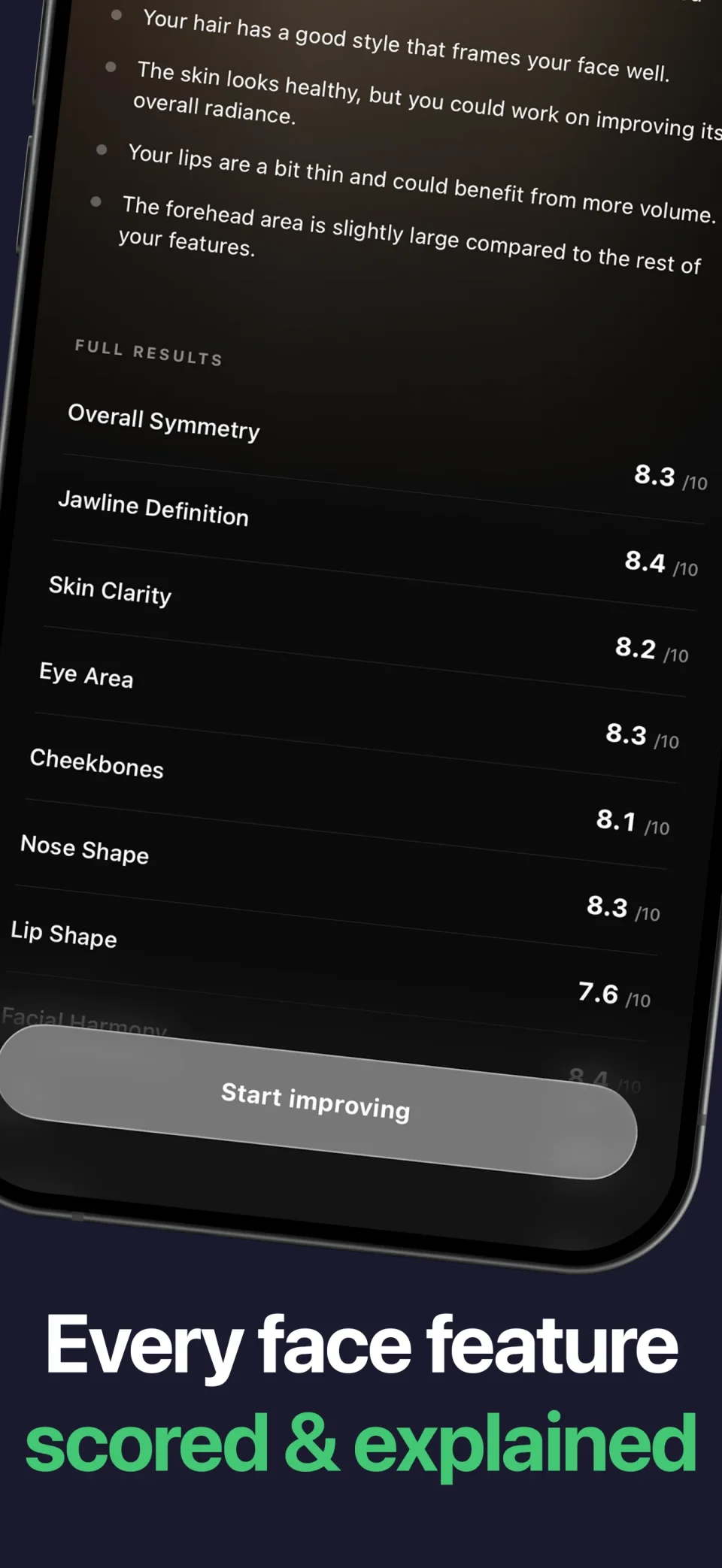
Lookist scores your eyes and eye brightness with a written note, and keeps your scans so you can compare them.
Download Lookist for iPhoneWhat is canthal tilt?
Each eye has two corners. The inner one, near the nose, is the medial canthus. The outer one is the lateral canthus. Canthal tilt is the slope of the line that joins them. Doctors also call it the palpebral fissure inclination or the intercanthal axis.
The term went viral on looksmaxxing TikTok. There, people call a positive tilt a must-have and a negative tilt a flaw. The measurement is real and surgeons use it. The idea that one angle decides how good your face looks is not.
How canthal tilt is measured
Researchers mark the inner and outer corner of each eye on a straight front photo. They draw a line through the two points and measure its angle against a true horizontal line. The face must be level, so studies correct for head roll first. One 2023 study subtracted the face rotation angle from each eye, then averaged the two eyes.
That correction matters more than anything else. Tilt your head 3 degrees and one eye gains 3 degrees while the other loses 3. Many viral "negative tilt" photos are just tilted heads.
How to measure your canthal tilt on a photo
The canthal tilt tool on this site does the math in your browser, and the photo stays on your device. If you would rather do it by hand, these steps give you a usable number.
- Take a front photo in even light, with the phone at eye height and at least an arm's length away.
- Keep a neutral face. Do not smile, squint or raise your brows, since each one moves the eye corners.
- Open the photo in any editor that shows pixel positions, or open the canthal tilt tool.
- Check that your head is level: the two pupils should sit at the same height. If they do not, rotate the photo until they do.
- Mark the inner corner of one eye, where the upper and lower lids meet near the nose.
- Mark the outer corner of the same eye, where the lids meet on the outside.
- Measure the height difference (rise) and the width (run) between the two points in pixels.
- Work out the angle: tilt in degrees = arctan(rise / run). A rise of 5 pixels over a run of 60 pixels is about 4.8 degrees.
- Repeat for the other eye and average the two. A difference of a degree or two between eyes is normal.
Canthal tilt chart: negative, neutral and positive
There is no official cutoff. Clinics, forums and studies draw the lines in different places, so treat this table as a guide, not a diagnosis. The averages in the last column come from the studies cited on this page.
| Band | Angle | What it looks like | How common |
|---|---|---|---|
| Negative | Below 0 degrees | Outer corner lower than the inner corner. Can read as tired or sad. | Less common in young adults |
| Neutral | 0 to about 4 degrees | Corners close to level | Common, around the average for white adults |
| Positive | About 4 to 8 degrees | Outer corner a little higher | Common, the average range in many studies |
| Strong positive | Above about 8 degrees | Outer corner clearly higher, almond shape | Average for Korean young adults and attractive female faces in one study |
What is a normal canthal tilt? The published numbers
Here is what real measurements found. Each study used a different group and method, so the numbers do not line up perfectly. Together they show that a small positive tilt is the norm, not a rare gift.
- About 4.1 degrees: average white face, as cited in a 2023 study of attractive faces.
- 6.5 degrees (men) and 8.5 degrees (women): 42 attractive white celebrities, Liu and colleagues, 2023.
- 5.1 degrees (men) and 6.1 degrees (women): 200 South Indian adults aged 18 to 26, Vasanthakumar and colleagues, 2013.
- About 8.4 degrees: 76 Korean patients with an average age of 23, Lee and colleagues, 2020.
Positive vs negative canthal tilt: does it matter for looks?
Some research says tilt plays a part. In a 2007 experiment, judges preferred female faces with an edited, steeper eye tilt 93% of the time. The 2023 celebrity study found attractive faces of both sexes had more tilt than the general average. A 2026 survey of 763 people found that almost everyone picked an upward outer corner as the more feminine eye.
Other research shows it depends on the face. A 2012 study of composite faces found that attractive Asian faces had a less steep slant than average Asian faces. Attractive white and Black faces had a steeper slant. A strong tilt on one face can look odd on another.
A negative tilt is not a defect. It is a common variation, and lots of well-known actors have a neutral or slightly negative tilt. It mainly changes the expression the eye gives at rest, which can lean softer or more tired.
Does canthal tilt change with ethnicity and age?
Ethnicity: yes. The averages above run from about 4 degrees in white adults to about 8 degrees in Korean adults. An upslanted eye is more common in East Asian faces. Comparing your tilt to a chart built on a different group can mislead you.
Sex: women average about 1 to 2 degrees more tilt than men in the studies above.
Age: the bone and the outer corner stay put. The 1999 Rotterdam study of 320 people found age did not move the outer eye corner. What changes is the soft tissue around it: the lower lid sags, and in some people loose skin hooding over the outer corner hides it. A 2026 study of East Asian adults with outer lid hooding measured an average tilt of only 3 degrees before surgery.
Can you change your canthal tilt?
Bone and the tendon that holds the outer corner set the true angle. Without surgery, it does not change. What you can change is how the tilt looks.
What changes the look
Makeup does the most. A winged liner or a shadow that lifts at the outer corner draws the eye up and out. Brow shape helps too: a brow tail that lifts a little makes the whole eye look more upturned. A brow that drops at the tail does the opposite.
- Eyeliner or shadow that flicks up at the outer corner
- Brows groomed so the tail does not droop below the head
- Enough sleep and less morning puffiness, which keep the lids from sagging
- A level head in photos, since a small roll swings each eye by the same angle
What does not change it
Eye exercises, mewing, taping the eye corner and pulling the temples back do not move the tendon. Tape gives a temporary effect only while it is on. Bonesmashing can injure the eye socket and does nothing for the canthus.
Surgery is a medical decision
Canthoplasty and canthopexy reposition or tighten the outer corner. Surgeons mostly use them to repair a lower lid that sags or turns out, and some clinics offer them for looks. Risks include dry eyes, a lid that pulls away from the eye, an odd corner shape, and the result slipping back over time. Thread lifts and brow lifts are other options clinics sell. Any of these needs a consultation with a board-certified oculoplastic surgeon, not a TikTok verdict.
Source: American Society of Plastic Surgeons: eyelid surgery (blepharoplasty)
Why your canthal tilt reading changes between photos
If you measure three selfies and get three different numbers, the photos are the problem, not your eyes. The outer corner is soft tissue, so anything that moves the lids moves the reading. A difference of 2 or 3 degrees between photos is common.
- Head roll: a head tipped a few degrees adds that angle to one eye and takes it from the other.
- Smiling: the cheeks push the lower lids up and change where the corners appear.
- Squinting or raised brows: both pull the lids and shift the outer corner.
- Chin up or down: a chin tilted up makes the tilt look smaller, and a chin tucked down makes it look bigger.
- Close selfies: a lens a few inches from your face bends the edges of the face, including the outer eye corners.
- Filters and beauty modes: many lift the outer corners on purpose.
Canthal tilt calculator: using the tool on this site
The canthal tilt tool reads one front photo in your browser and returns the angle for each eye in degrees. The photo stays on your device. It corrects for head roll using your pupils, so a slightly tilted selfie still gives a fair number.
Run it two or three times with different photos from the same setup. If the readings sit within a degree of each other, trust the average. If they swing a lot, fix the photo first: light, distance and a level head.
How Lookist fits in
Lookist does not output a canthal tilt angle. It gives an overall score out of 10 and 15 feature scores from one front photo, each with a written note. The eyes and eye brightness scores cover this area. The symmetry and facial harmony scores show how your eyes sit with the rest of your face.
If you care about the eye area, the useful part is scan history. Scan in the same light every couple of weeks and compare. Sleep, puffiness and brow grooming can show up there. Your tilt will not, because it does not move.
Frequently asked questions
What canthal tilt is hunter eyes?
Forums usually want a clearly positive tilt, often more than about 4 degrees, together with deep-set eyes, little upper lid showing and low brows. Tilt alone does not make hunter eyes.
What is the most common canthal tilt?
A small positive tilt. Published averages run from about 4 degrees in white adults to about 8 degrees in Korean adults. Women average a degree or two more than men.
Does canthal tilt change as you age?
The outer eye corner itself stays in place, according to a study of 320 people aged 10 to 89. The lower lid can sag and loose skin can hood the outer corner, which makes the tilt look smaller in some older adults.
Is it possible to get positive canthal tilt?
Only surgery changes the real angle, and that is a medical decision with real risks. Makeup, brow shape, good sleep and a level head in photos change how the tilt looks.
Is canthal tilt genetic?
Mostly, yes. Your genes set the shape of the eye socket and where the outer corner tendon attaches. That is why averages differ between ethnic groups.
Is a negative canthal tilt bad?
No. It is a normal variation and does not affect eye health on its own. It can make the resting expression look softer or more tired, and many well-known faces have it.
How accurate is a canthal tilt calculator?
It is only as good as the photo. Head roll, a smile or a close selfie can shift the result by several degrees. Use a level, neutral, arm's-length photo and take the average of a few readings.
Can one eye have a different canthal tilt?
Yes. A difference of a degree or two between eyes is common, because no face is perfectly symmetrical. A sudden change in one eye or eyelid is a reason to see a doctor.
Sources and product details
- Liu and colleagues, 2023: sexual dimorphism in 42 attractive faces, including canthal tilt (Aesthetic Surgery Journal Open Forum)
- Vasanthakumar and colleagues, 2013: palpebral fissure dimensions in 200 South Indian adults (Oman Medical Journal)
- Lee and colleagues, 2020: orbital dystopia and canthal tilt in 76 Korean adults (Journal of the Korean Association of Oral and Maxillofacial Surgeons)
- Bashour and Geist, 2007: is medial canthal tilt a cue for facial attractiveness? (Ophthalmic Plastic and Reconstructive Surgery)
- Jabbour and colleagues, 2026: eyelid features and perceived femininity, a survey of 763 people (Ophthalmic Plastic and Reconstructive Surgery)
- Rhee and colleagues, 2012: eyelid shape of different races, with reference to beauty (Aesthetic Plastic Surgery)
- van den Bosch and colleagues, 1999: eyelid anatomy and the effects of sex and age (British Journal of Ophthalmology)
- Lv and colleagues, 2026: outer upper eyelid hooding and lateral canthal tilt in 85 East Asian patients (Aesthetic Plastic Surgery)
- American Society of Plastic Surgeons: eyelid surgery (blepharoplasty)
- Lookist on the App Store
For photo handling and account controls, read our privacy policy. For an issue with Lookist, visit support.
Put your report to use
Lookist scores your eyes and eye brightness with a written note, and keeps your scans so you can compare them.
Download Lookist for iPhone