How to lose face fat: what works, what doesn't, and why you can't target it
You lose face fat by losing body fat overall. You cannot burn fat from one spot, and face exercises do not target it. Eat in a small calorie deficit, get enough protein, lift and do cardio, and sleep well. Cut late salt and alcohol, because water retention makes a face look fuller than its fat level. Track it with photos taken the same way each time.
Take a front photo in Lookist and compare your jawline, chin and cheekbone scores across scans as your face gets leaner.
Download Lookist for iPhoneCan you lose fat only from your face?
No. Your body decides where it takes fat from, and you cannot steer it with exercise. People call this idea spot reduction. Studies keep testing it and keep finding it does not work.
In one trial, 24 adults did seven ab exercises, five days a week, for six weeks. Their abs got stronger. Their belly fat, waist size and skinfolds did not change compared with a control group. In another trial, people trained only one leg for 12 weeks. They lost fat, but from the arms and trunk, not from the trained leg.
Your face works the same way. Chewing, puffing your cheeks and jaw drills use face muscles. The fat over those muscles drops only when your total body fat drops.
Why does my face look fat?
Three things make a face look full: fat, water and structure. Fat changes over weeks. Water changes over hours. Structure, meaning your bones, muscle size and how your fat pads sit, changes very little.
Fat on your face tracks fat on your body closely. A 2018 review pooled studies where people guessed body mass index from face photos alone. Their guesses matched the real numbers well (correlation 0.71). So if your body fat goes down, your face will show it.
Water is the fast part. Salt, alcohol, short sleep and lying flat all shift fluid into your face overnight. That is why your face can look rounder at 8 am than at 6 pm on the same day.
How to lose face fat: a 7-step plan
This is the plan that the research supports. None of it is about your face directly. All of it shows up in your face.
- Take three baseline photos today: front, left side and right side, in daylight, at arm's length, with a neutral face.
- Eat a little less than you burn. Aim to lose about 0.5 to 1 kg (1 to 2 lb) a week, not more.
- Get protein at every meal: eggs, Greek yogurt, chicken, fish, beans, tofu or lean meat.
- Lift weights two or more days a week and move most days. Walking counts.
- Keep salt and alcohol low in the evening, because both make your face hold water overnight.
- Sleep 8 to 10 hours if you are a teen, and at least 7 if you are an adult.
- Retake the same three photos every two weeks and compare them side by side, not from memory.
How big should your calorie deficit be?
A calorie deficit means you eat and drink a little less energy than you use. Your body covers the gap from stored fat. The NHS says an average man needs about 2,500 kcal a day and an average woman about 2,000. Your own number depends on your size, age and activity.
The NHS suggests losing 0.5 to 1 kg (1 to 2 lb) a week and warns against crash diets. A slow loss is easier to keep up, and you keep more muscle. If you are still growing, do not diet hard. Eat regular meals, cut sugary drinks and snacks, and let activity do more of the work.
You do not need to count every calorie. Pick two or three changes you can keep for months. For example, swap soda for water, cook more at home, and stop eating when full. If your weight has not moved in three to four weeks, make one more change.
What should you eat and how should you train?
Protein helps in two ways. It keeps you full, and it helps you keep muscle while you lose fat. A 2015 review in the American Journal of Clinical Nutrition looked at weight-loss diets. Higher-protein diets led to more fat loss and kept more muscle than lower-protein diets. Weight-loss trials often use about 1.2 to 1.6 g of protein per kg of body weight a day.
The NHS advises adults to get 150 minutes of moderate activity a week, plus strength work on two days. People aged 5 to 18 should average 60 minutes of activity a day. Lifting does not burn face fat directly. It keeps your body lean while the deficit removes fat, so you look tighter rather than just smaller.
Cardio and lifting both work. Pick the type you will still do in two months.
Salt, alcohol, sleep and water: the puffy side of face fat
Some of what people call face fat is water. You can change that part within a day or two. The table below sorts the common factors by how fast they act and how good the evidence is.
The NHS sets the adult salt limit at 6 g a day, about one level teaspoon. Most salt hides in bread, sauces, chips and takeout, not in the shaker. A large 2019 survey of women found heavy drinking (8 or more drinks a week) linked to more under-eye puffiness. In a sleep study, faces after one short night and a night awake looked more swollen around the eyes.
| Factor | Effect on your face | How fast | Evidence |
|---|---|---|---|
| Body fat | Fuller cheeks, softer jaw, more fat under the chin | Weeks to months | Strong: face fullness tracks body mass index |
| Spot exercises | Stronger muscles, no fat loss in that area | No effect on fat | Strong: spot-reduction trials found no local fat loss |
| Salt | Water retention and morning puffiness | Hours to a day | Good: NHS lists salty food as a usual cause of swelling |
| Alcohol | Under-eye puffiness, redness | Next morning, and over years | Moderate: large survey linked heavy drinking to puffiness |
| Short sleep | Swollen eyes, droopy look, paler skin | Next morning | Moderate: controlled photo study |
| Water intake | Little direct effect on face fat | Not clear | Weak: drink to thirst, 6 to 8 glasses is the NHS guide |
| Age and genes | Where your fat sits and your bone shape | Years | Strong: twin studies show high heritability for face size |
Do facial exercises get rid of face fat?
No study shows facial exercises burn face fat. The study people quote most is a small one from Northwestern University, published in JAMA Dermatology in 2018. It tested something else.
It enrolled 27 women aged 40 to 65, and 16 finished. They did 30 minutes of face exercises daily for 8 weeks, then every other day until week 20. Dermatologists rated their upper and lower cheeks as fuller. Their estimated age fell from 50.8 to 48.1 years. There was no control group.
So the result was more fullness, not less fat. The authors suggested the cheek muscles grew. That might help an older face that has lost volume. It is close to the opposite of what you want if your goal is a leaner face.
How to lose face fat fast
The fast changes are water, not fat. If you have an event in two days, skip salty takeout and alcohol. Sleep 8 hours, with your head a little raised. Your face can look noticeably less puffy the next morning.
Real fat loss is slower. At 0.5 to 1 kg a week, most people see a clear change in the face after several weeks. There is no fixed number. Many people notice the change in their face first, because small changes stand out on a face.
Skip crash diets, water pills, laxatives and sweat suits. They pull water out short term, it comes back, and they can make you unwell.
Does face fat go away on its own?
Sometimes, partly. Faces change shape through the teen years as the jaw and nose grow. But fat does not simply melt away with age. An MRI study measured the buccal fat pad, the deep fat in your cheeks. Its volume went up with age and body mass index, not down.
The same study found large differences between people. Two people at the same body fat can have very different cheek fullness. That part is mostly genetic. A twin study found that genes explain more than 70% of the variation in face size.
So if you are lean and your cheeks are still full, more dieting may not change much. That is your structure, and it is normal.
When a full face is not fat
Some full faces have nothing to do with diet. Check this list before you cut calories further.
If your face got rounder quickly without a clear reason, see a doctor. That is the one warning on this page, and it matters.
- Bone and genes: a wide jaw, high cheekbones or a short face read as full even when lean.
- Buccal fat: the deep cheek pad varies a lot between people and does not track diet closely.
- Big masseter muscles: heavy chewing or clenching can widen the lower face. See the chewing gum guide below.
- Cushing's syndrome: a red, round face, more fat on the neck and upper back, and stretch marks. The NHS says the most common cause is long-term, high-dose steroid medicine. Do not stop a steroid on your own. Talk to the prescriber.
- Underactive thyroid: MedlinePlus lists a puffy face, hands and feet as a late sign when it is not treated. Other signs include tiredness, weight gain and feeling cold.
- Swelling from allergies, infections or medicines, which usually comes and goes faster than fat.
Source: NHS: Cushing's syndrome
How to track face fat loss with photos
Your mirror is a bad judge, because you see your face every day and small changes hide. Photos work if every photo uses the same setup. Distance matters most: a close selfie makes the middle of your face look wider.
- Use the same spot, facing a window, at the same time of day. Late morning works well.
- Hold the phone at eye level, at arm's length or farther, or use a timer and a stand.
- Keep a neutral face, mouth closed, teeth together lightly, hair off your forehead.
- Take front, left and right photos. Turn your whole head for the side photos.
- Compare the first and latest photos side by side every two to four weeks.
- Note your sleep, salt and alcohol from the night before, because water can hide a week of fat loss.
Photo checklist for face analysis
Track your jawline and face with Lookist
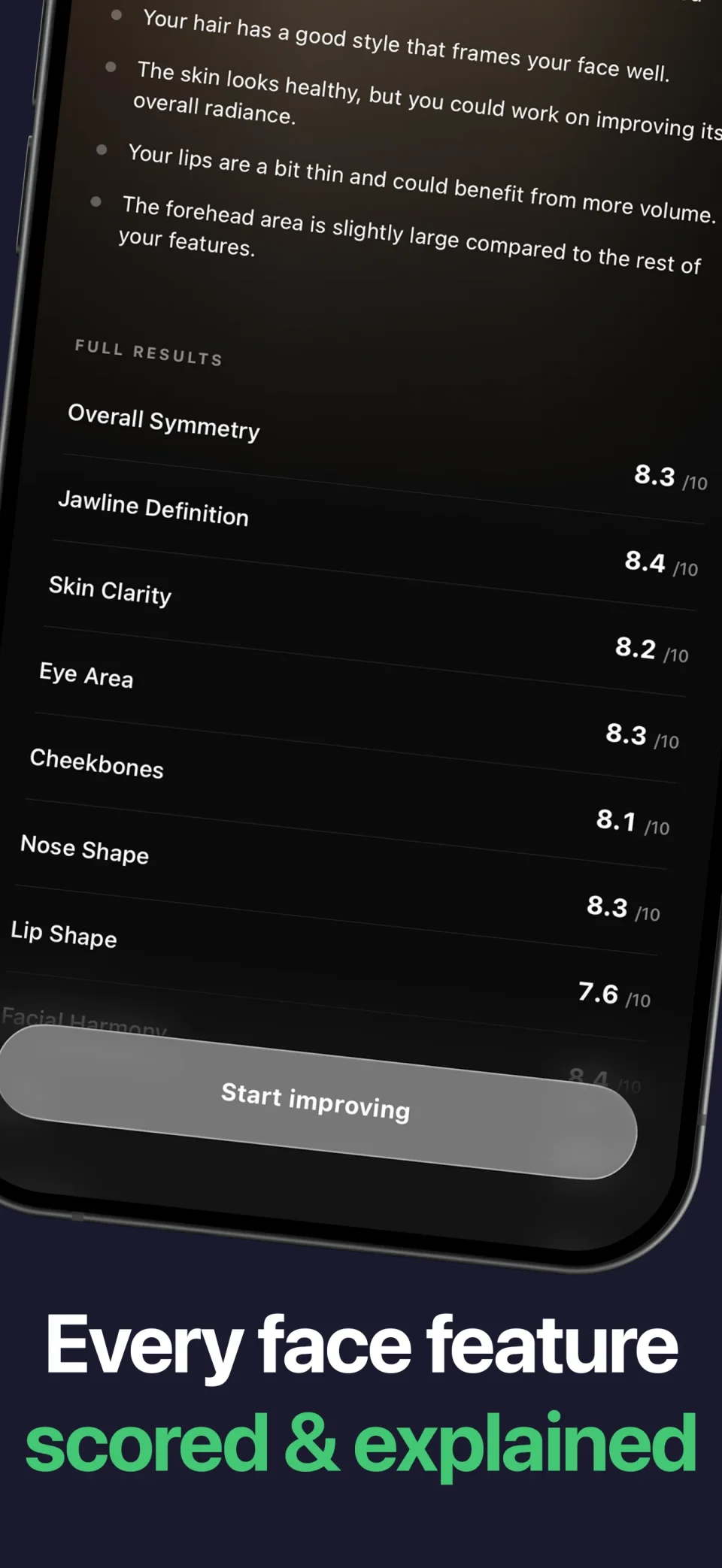
Lookist reads one front photo. It gives an overall score out of 10 plus 15 feature scores, each with a written note. For face fat, the useful ones are jawline, chin, cheekbones and facial harmony.
Every scan goes into your scan history, so you can compare past scans and scores as you get leaner. Use the same photo setup each time so the comparison is fair. The daily plan covers skin care, hair care and sleep reminders, which helps with the puffy side of things.
Frequently asked questions
Can you lose face fat in a week?
You can lose face puffiness in a day or two by cutting salt and alcohol and sleeping more. Fat loss in a week is small, about 0.5 to 1 kg of body weight at a sensible pace. The face usually shows a clear change after several weeks.
Does face fat go first when you lose weight?
Many people notice it in the face first, because small changes are easy to see on a face. Your body still takes fat from everywhere at once, in an order set mostly by your genes. You cannot choose the order.
Can face fat be genetic?
Yes. Genes shape your bones, your deep cheek fat pads and where you store fat. A twin study found genes explain more than 70% of the variation in face size. Two people at the same body fat can have very different cheeks.
Do facial exercises reduce face fat?
No study shows that. The best-known study, from 2018, found face exercises made cheeks look fuller in middle-aged women, likely from bigger muscles. Exercises do not burn the fat over the muscle.
Does drinking water help you lose face fat?
Water has little direct effect on face fat. It helps if it replaces sugary drinks, which cuts calories. The NHS suggests 6 to 8 glasses of fluid a day as a general guide.
Why is my face fat but my body is skinny?
Your bone structure, deep cheek fat pads or large chewing muscles can make a lean face look full. Morning water retention also adds fullness. If your face got rounder quickly with no clear reason, see a doctor. Some medicines and hormone conditions cause it.
Does chewing gum burn face fat?
No. Chewing uses very little energy and does not take fat from your face. Heavy chewing can make the jaw muscles stronger, but that is muscle, not fat loss.
How do I know if it is fat or bloating?
Take photos in the morning and the evening of the same day. If your face looks clearly slimmer by evening, a lot of what you see is fluid. Fat stays the same through the day.
Sources and product details
- Vispute and colleagues, 2011: The effect of abdominal exercise on abdominal fat (J Strength Cond Res)
- Ramírez-Campillo and colleagues, 2013: Regional fat changes induced by localized muscle endurance resistance training (J Strength Cond Res)
- de Jager and colleagues, 2018: Facial adiposity, attractiveness, and health, a review (Frontiers in Psychology)
- NHS: tips to help you lose weight
- NHS: understanding calories
- Leidy and colleagues, 2015: The role of protein in weight loss and maintenance (American Journal of Clinical Nutrition)
- NHS: physical activity guidelines for adults aged 19 to 64
- NHS: physical activity guidelines for children and young people
- NHS: salt in your diet
- NHS: water, drinks and your health
- Goodman and colleagues, 2019: Impact of smoking and alcohol use on facial aging in women (J Clin Aesthet Dermatol)
- Sundelin and colleagues, 2013: Cues of fatigue, effects of sleep deprivation on facial appearance (Sleep)
- Paruthi and colleagues, 2016: Recommended amount of sleep for pediatric populations, AASM consensus (J Clin Sleep Med)
- Watson and colleagues, 2015: Recommended amount of sleep for a healthy adult, AASM and SRS consensus (Sleep)
- Alam and colleagues, 2018: Association of facial exercise with the appearance of aging (JAMA Dermatology)
- Volumetric variations in the buccal fat pad by sex, age, and body mass index: an MRI study, 2025 (Int J Oral Maxillofac Surg)
- Djordjevic and colleagues, 2016: Genetic and environmental contributions to facial morphological variation, a 3D twin study (PLOS One)
- NHS: Cushing's syndrome
- MedlinePlus (US National Library of Medicine): hypothyroidism
- Lookist on the App Store
For photo handling and account controls, read our privacy policy. For an issue with Lookist, visit support.
Put your report to use
Take a front photo in Lookist and compare your jawline, chin and cheekbone scores across scans as your face gets leaner.
Download Lookist for iPhone